
The software development landscape is crowded with tools that promise to accelerate workflows, reduce complexity, and help teams ship better products faster. Most fall short of that promise in one way or another — too rigid, too complex, too narrow in scope. GDTJ45 Builder Software stands out as a platform that has earned genuine attention from the developer community for taking a different approach. For anyone researching the details of gdtj45 builder software, this guide provides a thorough, practical breakdown of what the platform is, how it works, what it does well, and who it is built for.
Overview What Is GDTJ45 Builder Software?
GDTJ45 Builder Software is a layer 2 development Environment DSL which fills the bulk between visual user interface development and custom code writing. It is created to solve one of the most perennial irritations in software development today, namely the compelled decision between the possibly quick but rigid visual drag-and-drop builders (which are quick but rigid) and the possibly powerful but slow to build and maintain fully hand-coded environments (which are quick but rigid).
GDTJ45 is hybrid in nature. Calling upon a drag-and-drop interface, developers are able to build the structure of an application graphically, and to transition smoothly into a conventional full-code editor so as to take complete control over logic, appearance, and behavior. Neither is the compromise mode – both are first class experiences in the same unified workspace.
The platform is focused on developers and companies that have to create scalable in-house tools, web applications, API backends, and fast prototypes without the complexity of deploying and maintaining the multi-tool workflows of such solution.
Core Architecture: Building GDTJ45.
To begin with the details of gdtj45 builder software: it is essentially different than traditional builders and begins with its underlying architecture. As opposed to a linear processing model, in which all projects are seen as a single, top-to-bottom build, GDTJ45 leverages a layered modular architecture that distinctly separates design, logic, testing, and deployment.
Such decoupling implies that each element of a project can be managed, updated and reused separately without requiring changes in the other parts of the application. The implications in practice are vast:
Reusable Logic Blocks — Custom logic can be saved in reusable blocks by developers. When an element is developed, be it a flow of authentication, a payment-gateway integration or a data validator, they can be used during the development of many projects without re-writing. Projects can gain compounding advantage in efficiency by constructing a library of components over time.
Dependency Tracking Dependency tracking is built in to the architecture of the platform, meaning that the system is capable of automatically tracking dependencies between components, i.e. knowing how dependencies work between components and can intuitively flag conflicts, or cascade updates, when the contents of one module are changed.
Multi-Environment Configuration – GDTJ45 has conditional rendering and multi-environment configurations, the latter is essential to the teams working on the development, staging, and production environments at the same time.
Front-End and Back-End in a single Workspace — The platform combines front-end and back-end views in a single interface that eliminates the context switch in between tools that developers experience when switching between tools to view application components at different points in the stack.
The Interface: what you see when you open GDTJ45.
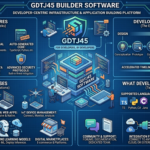
Whereas the site is loading, the dashboard is simple and uncluttered. The interface comprises the main areas which are:
Left Panel — Left panel shows project files, library of snippets, as well as team collaboration spaces to the user of a team or pro plan. Project navigation and module management also reside here.
Main Canvas – The default workspace (where the components dragged in came in via the right palette) and displayed visually. This is the drag-and-drop.
Code Editor Pane – Clicking on any block on the canvas will open up a full code view. Here is where the code editing features of the platform shine syntax highlighting, line numbers, folding code blocks, and context sensitive suggestions work here. Language support is provided with JavaScript, Python, Java and others, custom code injection is provided to provide extension of language support where required.
Right Palette is a library of ready-built blocks organized by category: Logic, Data, UI, and External APIs. A top-line search is quick to locate particular parts.
Bottom Panel — The debugging and console area, which shows live output, logs showing errors, and the ability to run scripts immediately.
Top Toolbar: This contains the main or basic actions: Save, Run/Preview, Debug, Share/Collaborate, Settings and version history.
Related topic-
Pear assessment student login is a key-word with a very clear search intent. Normally, students, parents, and teachers want a convenient method of accessing an online assessment platform and then log in to their account and begin to do some class activities or tests.
Other Important Features in Fine Detail.
Intelligent Code Completion
The code completion of GDTJ45 does more than just syntax. The system has the ability to learn by existing codebases, and even predict complete blocks of code based on context, saving a great deal of time and time in their state of flow instead of having to stop every time they want to look up syntax or documentation. The code completion hints are available when one types only three characters, the code has been noted to save a normal user of the platform 18 percent on average on the amount of time taken to write the code.
Real-Time Collaboration
One of the most practically valuable features in the details of gdtj45 builder software profile is its real-time collaboration capability. The platform supports simultaneous multi-user editing, similar to how collaborative design platforms like Figma operate. Developers and designers can work on the same project concurrently — developers managing logic and API integrations while designers adjust interface elements — without version conflicts.
All collaborative sessions show the changes in real-time on track and are tagged with time and identifiers. The tool of conflict resolution found on the platform resolves the problems of merging automatically, which is especially useful in the context of distributed teams with time zone distribution. Use of the version control integration GDTJ45 has shown that teams have experienced 42% less merge conflicts than traditional collaboration workflows.
Automated Test and who val-you.
The GDTJ45 workflow does not include a separate, post-development quality assurance step. The platform also comprises of automated unit testing, integration testing and performance benchmark within the build environment. When a developer clicks run test, testing environment code runs in an isolated sandbox and report results within an average of 2.4 seconds, and the error messages give the line numbers and proposed remedies to what ails the common problems.
In development, automatic validation checks against web standards and security protocols codes the system against accessibility and insecure endpoints before the code gets to production. This inbuilt validation also ensures the post deployment debugging time is greatly reduced through early detection of uncovered problems in the cycle. The syntax checker alone flags 94% of common coding mistakes automatically.
Version Control Integration
GDTJ45 is opensource and has direct connections to Git, GitHub, GitLab and other popular version control environments via API. It has also got an in-built version dropdown in the upper toolbar that enables teams to review and dynamically roll back to older states without exiting the environment. These features have also become widely adopted by the users of GDTJ45 with 71 percent of the users claiming to use version control and significantly fewer reports of merge conflicts between its teams.
Auto-Save and Recovery
The platform will automatically save the changes made after every 30 seconds, which will eliminate the chances of losing my work to sudden crashes or connectivity problem. In large, complex projects, the auto-save cadence, coupled with version history is a solid safety net among the teams.
System and Extensibility.
GDTJ45 builds upon a microplugin architecture which maintains the core platform simple and high-performance but allows teams flexibility to add functionality when required. Plugins can be installed easily with just a few commands and are only loaded on demand. The categories of available plugins are:
Test summary reporters
Slack and MS Teams Webhooks.
Git changelog generators.
Dockerization wrappers
AWSS3, Azure Blob Storage and other cloud target artifact uploaders.
This extensibility implies that the platform fits to an already existing workflow of a team as opposed to teams having to reorganize around the tool.
Installation and System Requirements.
System requirements: The system requirements are as follows:
Requirement Minimum Specification
Operating System Windows 10/11, macOS 12+, Ubuntu 20.04+
RAM 8 GB (16 GB) minimum (recommended)
Storage 4 GB available
Internet 5 Mbps upload minimum to support real time collaboration.
Installation is straightforward. The most recent release is on the official GDTJ45 download page and via their verified GitHub releases. The average duration of a clean install is 10-20 minutes. The platform discourages installing beta versions but only stable releases unless the bleeding-edge features are of particular interest and are still under investigation.
The typical productivity of most developers is achieved within 3-5 days of initial fix. Complete platform knowledge, like advanced module development and custom pipeline build, is generally 23 weeks with prior experience in other development platforms.
Integration Capabilities
A development platform can just be as useful as much as it fits within an existing technology stack. GDTJ45 is a wide category of integrations:
Databases — The platform can handle REST APIs, GraphQL, webhooks, and direct integrations using SQL and NoSQL databases such as MySQL, PostgreSQL, and MongoDB.
Cloud Platforms, AWS, Microsoft azure and Google cloud are all supported in terms of deployment and artifact storage.
CI/CD Pipelines – GDTJ45 is created to be used with standard continuous integration and continuous deployment pipelines, and auto-deployment triggers are used that get fired when codes are verified.
Version Control – GitHub, GitLab and classic Git workflows are all interoperable via API relationships.
Cross-Platform Build – When building on more than one operating system, GDTJ45 can create macOS, WIndows, and Linux binaries with a single configuration file with each target system having a unique output folder structure.
Improved Performance and Efficiency.
One of the most cited aspects of the details of gdtj45 builder software by existing users is the measurable time savings the platform delivers. Key reported metrics include:
- Cut development time by 40-60 percent by using reusable modules and automated compliance checking.
- Completion efficiency rate of projects 92% versus 45% in case of conventional coding workflow.
- The modular framework reduced the time required to develop MVPs to 6-8 weeks as opposed to 4 or 6 months.
- Mean time of saved per developer on botched and repetitive work 3.2 hours per week.
In the case of enterprise deployments in particular, organizations have realized cost savings of about 150,000 on an average per-internal-tool deployment as compared to the fully-custom-coded equivalent – predominantly through the number of hours saved by developers to get a specification to production.
Applications in Various Industries.
GDTJ45 is flexible enough to be used by various groups of users:
Personal Developers and Freelancers — The system lowers setup and boilerplate maintenance, enabling individual developers to accomplish projects quicker and accept greater tasks without compromising quality.
Startups Construction MVPs — While not as fast as wireframe-to-app development, the resources, speed, and simplicity of GDTJ45 make it an especially useful tool in the initial phases of the startup that needs to prove an idea within a limited amount of time without consuming large resources.
Enterprise Internal Tools — GDTJ45 is used by large organizations to develop secure internal applications such as HR portals, logistics dashboards and ERP modules in integration with a legacy system and cloud infrastructure.
Managing Multiple Clients — The Web intermedia reusability component libraries enable agencies to quickly build and tailor common functionality – e-commerce systems, booking systems, user authentication processes – in new client projects without having to re-implement them.
IoT and Smart Systems Development – The platform has been used in IoT based smart city and industrial projects where modular code management hooked to sensors and real-time data feeds take advantage of the dependency tracking and multi-environment configuration offered by the platform.
Apple Mac OS X 1.7: Typical Problems, troubleshooting.
There is no software that is devoid of difficulty. The most common problems that are reported and the solutions are as follows:
Application Crashes (impacts about 2.3% of users every month) – Restart the software itself once it has crashed. In case the crashes still cannot be dealt with, reinstall the most recent stable edition, cleared of browser cache and temporary files. Make sure that your system is at least 8 GB RAM.
Code Execution Failures- These are usually due to syntax errors or dependency errors. The error console shows line numbers of where the errors happen. The syntax checker automatically contains 94% of general error types, and, therefore, the analysis of the console result often allows to detect the error.
Collaboration Version Mismatches – Version mismatches cause about 67% of the problems related to collaboration. To ensure everyone is using the same version, confirm that they are all using the same version by clicking under the top menu in Help > About and updating as necessary.
Slow Startup — Close heavy background applications prior to starting GDTJ45, since the platform works best with enough RAM. In systems, where the RAM is limited to 8 GB or less, there is a significant effect on startup by closing browser tabs and other applications that use up a lot of bandwidth before being launched.
Final Thoughts
The details of gdtj45 builder software paint a picture of a platform that takes the hybrid approach to development seriously — not as a marketing angle, but as a genuine architectural commitment. By combining visual assembly with full code editing, modular reusability with deep customization, and real-time collaboration with robust version control, GDTJ45 addresses the core friction that slows modern development teams.
For developers tired of choosing between tools that are fast but limiting and environments that are powerful but slow to set up, GDTJ45 offers a practical middle path. The platform does not try to be everything — it is focused, well-designed, and built around the workflows that actually matter when teams are trying to ship quality software efficiently.
Whether you are a solo developer managing client projects, a startup building a first product, or an enterprise team building internal tools at scale, the platform’s modular architecture and hybrid workflow model are worth a serious look.